Tuesday, April 19, 2011

TWO QUESTIONS YOU SHOULD BE ASKING ABOUT LIBERAL ENVIRONMENTALISM


After reading in this blog about Liberal Environmentalist policies that: 

1. Exterminated a “Threatened” fish those policies were alleged to save.
2. Attempted to cover up mistake #1 by poisoning an entire stream killing all living things in it, including any other “threatened species” that might live there. On top of all this the poison has been shown to pose a threat of causing onset of Parkinson’s Disease in humans. 
3. Advocate a “restoration” policy that actually has been shown to have made things worse in 60+ years of a trial created to demonstrate the policy's effectiveness.

And... 

After seeing dramatic evidence in comparison photographs revealing that Conservative Environmental policies succeeded in the same cases where liberal methods failed so miserably. (See (name posts))

You should be asking yourself at least two questions.

First:
What are Liberal Environmentalists really trying to do? (Because saving fish, restoring ecosystem health, and the like are obviously not their main goal. In fact they don’t seem to be their goal at all) 

And the second question, which I find much more interesting: 
Why does Nature respond so much more positively to Conservative Environmentalism than to Liberal Environmentalism? 

The quick answer to the second question is: Because Nature is a conservative..., but we’ll get to that in a minute. First I’d like to tackle question #1...

What are Liberal Environmentalists really trying to do?

I’ve spent the last 10 years of my 35+ year career as an environmental activist puzzling over how people who profess to be absolutely dedicated to the environment and its health could harm it in ways such as those I have described in this blog and act as if nothing was wrong.

How could they keep working and fighting so hard to do what they do even though in many cases their actions achieve the exact opposite of what they claim is their life’s purpose? 

FOLLOW THE MONEY?
Some have explained this disconnect by suggesting that environmentalists really don’t care about the environment; that they do what they do because it brings them political power and money, and because it enables them to feel holier than the rest of us, or smarter, or smugger, or greener. Some say environmentalists do what they do because they are socialists or marxists and claiming to defend the environment from capitalism justifies their efforts to destroy it.

All of the above is true, but not in the way most of us think. Actually it is true in a way that even liberal environmentalists are not aware of. Most of the environmentalists I know say that money and power really don’t matter to them. That they are activists purely and solely because of their concern for the health and future of the environment. And I believe they mean that, but consider the following...

All environmentalists I know say they want to “protect” the environment. Nearly every environmental group I know of has the word “protection” either in their name or in their mission statement. (There’s even a group named “Republicans for Environmental Protection.”)

In our society the institution responsible for protecting things is the government. For that reason, whether intentional or not, “protecting the environment” inevitably happens via the government. This puts contemporary environmentalism inescapably in the big government/liberal camp because liberals are the ones who try to solve everything via the government and regulation. 


IF IT MOVES REGULATE IT
For instance: When the banking system almost collapsed in 2008 all we heard from liberals is: The banks need to be more regulated.
When the BP Deep Water Horizon oil well blew up and started spewing oil into the Gulf of Mexico the only solution liberals could conceive of was more regulation.
When Dems declared our health care system didn’t work, the solution, they said, was — more regulation
Global warming — more regulation
Global cooling — more regulation
Severe weather — more regulation
Unemployment too high — more regulation
Economy in crisis — more regulation
Too much oil from overseas— more regulation
Some people have more money than others— more regulation
Endangered species — more regulation
You name it — more regulation, or, in other words, more protection, which means more government.

And in every case, the programs created to administer these regulations — Affirmative Action, Planned Parenthood, Public Health Care, Environmental Protection, Wilderness Designation — extend the authority of government into areas of our lives that range from the most momentous (having or not having children) to the most trivial (what light bulbs we can use.) This, in turn, expands the power over our lives of liberals who advocate and administer these programs.

In other words programs that protect and regulate actually pump political power into the hands of the protectors.


THIS WILL GET YOUR ATTENTION!
Here’s an illustration...

The illustration starts with a question: What modern government passed the first wilderness law, the first endangered species act, the first animal rights laws, the first antivivisection law, was the first to protect wolves, and the first to ban DDT? (Hint: This government was not in the U. S.)

Answer: Nazi Germany passed The Reichsnaturschutzgesetz law (Reich Nature Protection Act) in 1935. The purpose of the act, according to Duncan Bayne in How To Spot a Nazi, was to enable the Nazis to use their purported desire for “preventing harm to the environment" as a justification for increasing control over the German populace. One way in which that worked was by requiring that decisions on how a person could use their property had to be first approved by the Reich. (Sound familiar?)


Nazis considered themselves protectors of the animals as per this cartoon of
rabbits and other animals giving the Nazi salute to Hermann Goering.

Knowing what we know about Nazis, which criterion do you believe German fascists used to judge the success of this law: Whether it protected the environment? or, Whether it expanded their political power?

I’d bet on the latter.

In the same way that the Reich Nature Protection Act expanded the political power of the Nazis in early twentieth century Germany, environmental laws are expanding the political power of the left in the contemporary USA and extending it into all corners of our lives. 

Please note that I’m not saying liberal environmentalists are Nazis or that they hate Jews or want to start a World War. However, there are striking similarities between the two political movements. Both allege that they are the one and only true friend of Nature. Both believe that they are mankind’s only hope to avoid destruction, that they are destined, no, required to lead, and that they are the only ones with the answers and the remedy to heal what ails the world. 

With that as a basis, the Nazis believed and contemporary liberal environmentalists believe that there is no aspect of your life so personal, so private, or so trivial that they should not control it. (In this regard enviros may even be outdoing the Nazis. I know of no attempt by the Third Reich to control the number of sheets of toilet paper you should use or to dictate how much salt you put on your food.)

(See note below for something too outrageous to include here.)

I also believe that this provides us with the answer to question # 1: What are Liberal Environmentalists really trying to do? (Because saving fish, restoring ecosystem health, and the like are obviously not their main goal.), 

Environmentalists didn’t admit failure when their removal of cattle from along the Verde River apparently caused the demise of the Verde River spikedace for the simple reason that, for them, it wasn’t a failure. They succeeded in forcing the U. S. Forest Service to remove cattle and private management from public lands along the river, which is what they intended to do. Concern for the spikedace merely provided the cover and the means to do the job. In other words, they achieved their goal. They increased their political power.

Dead spikedace or no, the program was a success.

WHY YOU SHOULD READ THIS BLOG (BECAUSE IT PROVIDES EVIDENCE OF LIBERALISM’S FAILURES FROM A NEW SOURCE: NATURE HERSELF)
Last, but not least, consider this footnote. Conservative pundits have been telling us for years that liberal programs such as the War on Poverty, Affirmative Action, etc. are a failure, but the evidence they provide is at least open to interpretation. The case of the Verde River spikedace, the Drake Exclosure, the Southwestern Willow Flycatcher and others yet to come on this blog give us concrete evidence that liberal programs don’t work — evidence in the form of dead fish, barren landscapes, and birdless habitats. Better yet, that evidence is provided by none other than Nature itself.

Environmentalists have a saying: “Nature bats last.” On this blog, she bats next when we consider question #2: 

Why does Nature respond so much more positively to Conservative Environmentalism than to Liberal Environmentalism?

Stay tuned.

NOTE:
(I include this here, because if I had added it earlier, it would have overshadowed this post to the point that you might not have been able to read the rest of it, let alone remember it.)

The most chilling similarity between Contemporary Liberal Environmentalists and Hitler’s Nazis is: The “solutions” offered by both for the world’s problems, environmental and otherwise, include the elimination of huge numbers of humans. For instance, when the “2006 Distinguished Texas Scientist,” advocated the elimination of 90 percent of Earth's population by airborne Ebola (a viral disease that causes people to bleed to death through their bodily orifices). He was given a standing ovation by the Texas Academy of Science.

Friday, April 1, 2011

ANOTHER AMAZING ECOSYSTEM RESTORATION!

AND ANOTHER SKELETON 
IN LIBERAL ENVIRONMENTALISM'S CLOSET
CONSERVATIVE ENVIRONMENTALISM
READ THE STORY BELOW

The Gila River in New Mexico after a devastating flood

Same place after restoration
WHAT HAPPENED?!
While I’m asking whether Conservative Environmentalism or Liberal Environmentalism works best and revealing the skeletons in Liberal Environmentalism’s closet, the above photos lead us to another skeleton. This one is described in detail in my latest book, Gardeners of Eden, Rediscovering Our Importance To Nature (So were the other failures of Liberal Environmentalism I’ve pointed out so far. If you want more detailed accounts read Gardeners).

But before I get to that other skeleton I’d like to say a few things about my book. Actually, I’d like to tell you a few things others have said about it. 

One reviewer on Amazon.com was almost too enthusastic.

“There are few books that conjure a simultaneously bizarre reaction within a soul: like a biblical epiphany, Dagget stirs new paradigms that made me so excited that I could barely put down the book to complete my daily tasks. Yet, I could not turn the page to the next chapter because the elegant revelations of our place in nature evoked so much thought and "wow", that muddying the gift of a previous chapter with another would do it no justice.” 

This book is in my life's top ten list!"

A representative of a Native American college on an Indian reservation in North Dakota gave the book a unique compliment while inquiring about my availability to make a presentation at the college. I believe few other environmental books have had this said about them.... 

“I personally read Gardeners of Eden last year and was thrilled to see how similar the philosophies in the book are to the Lakota way of thinking.”  

A pre-publication reviewer (a liberal environmentalist, by the way) called Gardeners of Eden,

“the most important environmental manifesto since Aldo Leopold’s Land Ethic.”

If you want to do a little more discovering about your importance to the environment you will want to check this book out. It is available at Amazon.

Now, getting back to that skeleton. This one involves an endangered bird — the Southwestern Willow Flycatcher. the following exerpt is directly from the book.

On a working cattle ranch (the U Bar) in southwestern New Mexico, David Ogilvie (the ranch manager) has managed a riparian area along the Gila River to such a state of health that it: 

• is home to the largest known population of one endangered species (the southwestern willow flycatcher) and two threatened species—the common black hawk and spikedace (a fish).

• supports significant populations of several other rare species, some of which are candidates for listing;

• is inhabited by the highest density of nesting songbirds known to exist anywhere in North America; and

• has one of the highest known ratios of native to nonnative fish (99 percent to 1 percent) in the Southwest.

Ogilvie restored an area of riverside habitat that had been severely damaged by flood to a condition known, because of previous experience on the U Bar, to be especially friendly to the southwestern willow flycatcher. As a result, the endangered flycatcher population in that restored stretch of habitat increased from zero in 1997 to twenty-three pairs in 2002. At the time, that was the fifth largest population known. Recently, a population of a species of frogs listed as threatened was discovered on the ranch too.

(HERE'S THE SKELETON!)

The real measure of the environmental value of Ogilvie’s management is best revealed, however, by comparing the flycatcher population of the U Bar’s riparian habitat to two nearby preserves that combine to make up a comparable amount of similar habitat. In 2002, scientists counted 156 pairs of southwestern willow flycatchers on the U Bar. The two preserves had a combined total of zero!

When I mentioned this to a well-known environmental activist and author, he said he didn’t view this as a success at all. He viewed it as equivalent to creating a garbage dump that attracted grizzly bears and calling that dump good bear habitat. (I assure you that the U Bar is no “garbage dump.” To decide for yourself, take a look at the accompanying photos. (shown above)

A few matters of clarification: The "after the flood" picture above is not a picture of the preserves. Actually, the preserves don't look that different than the ranch (except to a Southwestern Willow Flycatcher). 

SELLING SKELETONS

So, are environmentalists studying what Ogilvie is doing to make the ranch he is managing so attractive to so many species?

No! They're trying to remove his management from the habitat along the river where it has proved so exceptional in order to make that area more like the "preserves" which the flycatchers and other species I have mentioned avoid.

This gives rise to two very important questions which are the subject of the next post coming soon.

Monday, March 21, 2011

CONSERVATIVE ENVIRONMENTALISM:
THE MOST AMAZING ECOSYSTEM RESTORATIONS EVER

HERE THEY ARE. All achieved by USING THE LAND, not by protecting it.
Click once for a close-up, twice for an extreme close-up.


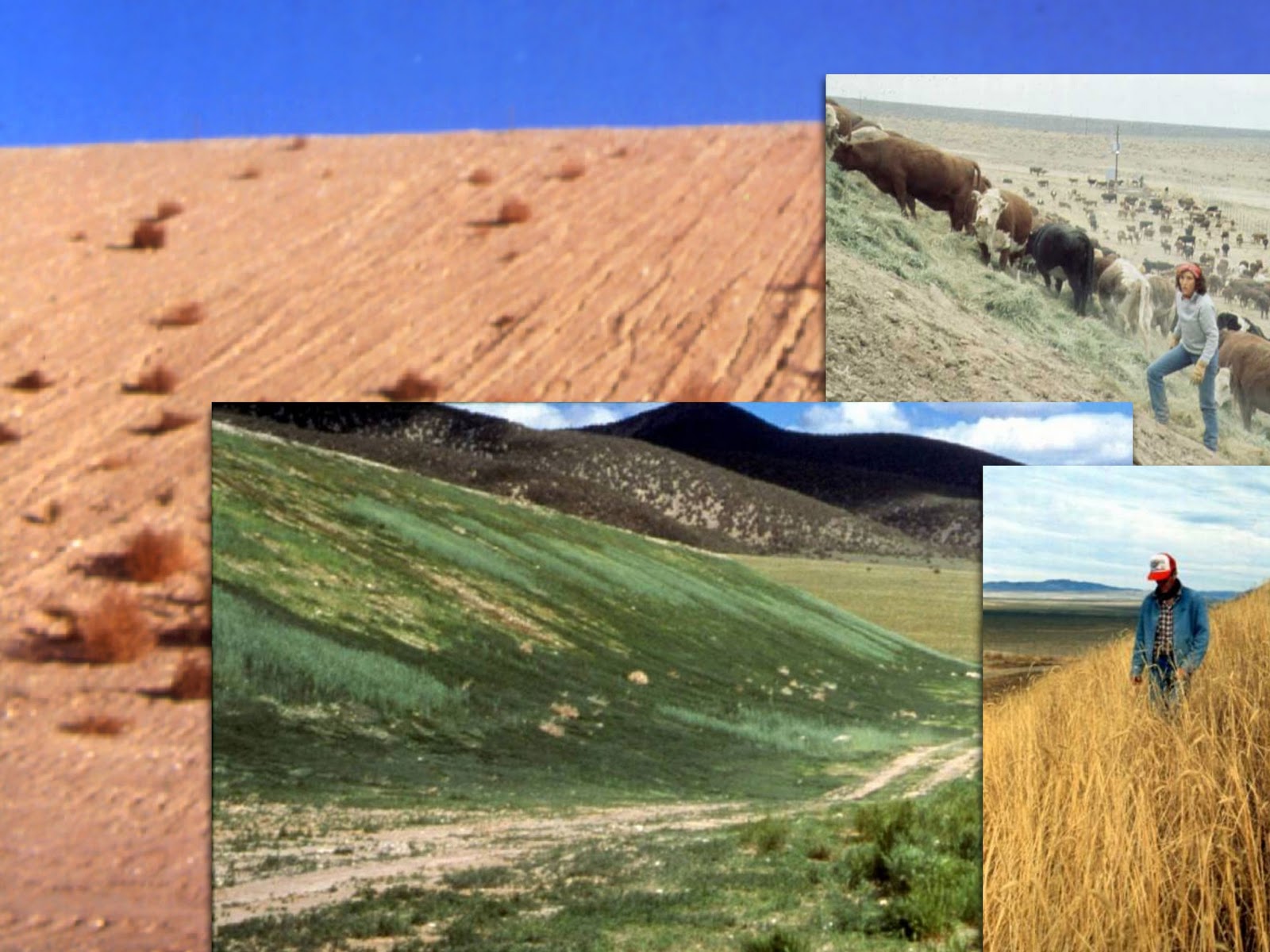
The photo sequence above was taken at a gold mine in central Nevada. The restoration started with the mine, already unsuccessfully reclaimed (upper left). Then Nevada ranchers Tony and Jerrie Tipton applied seeds, organic material (hay), animals (cows), and allowed the land to gestate over the winter. The results are shown the following spring and at the end of the summer growing season.

The next amazing restoration involves a pile of copper mine tailings in Arizona. Same formula, same results. This was a superfund site on which standard reclamation techniques had failed also. Then Arizona rancher Terry Wheeler applied the technique he was the first to envision. It worked under the most difficult conditions imaginable.. More than ten years later it is still working.


The restoration picture below was achieved by me and my partner Norm Lowe. The challenge was a gravel mine on the Coconino National Forest near Flagstaff, AZ. The first photo (two photos spliced) shows the mine. Next is Norm broadcasting seeds. (Look at how rough that ground is!) Then a cowboy spreading hay, the cows doing their work, and then the results. Click any of the photos once for a close-up, twice for an extreme close-up.

Sunday, March 20, 2011

CONSERVATIVE ENVIRONMENTALISM vs LIBERAL ENVIRONMENTALISM

WE REPORT, YOU DECIDE

This post gives you the opportunity to judge the results of Conservative Environmentalism versus the results of Liberal Environmentalism via compared photographs, Unless otherwise noted, the photos were taken in the same area (in some cases the areas were directly adjacent to one another) at relatively the same time. In cases where the methods used to get the results shown aren't obvious, those methods are illustrated with a simple photo sequence showing the techniques applied.

In other words: We report and give you the opportunity to decide which works best: Conservative Environmentalism or Liberal Environmentalism.


PROTECTED SINCE 1946
This first photo shows an area in Central Arizona on which the land management strategy Liberal Environmentalism says will heal all that ails the land has been applied. This land has been protected from all use by humans since 1946 when a fence was erected around it to create a study plot. What did this plot look like when it was first protected? “Pretty much like it looks now, but the trees were smaller,” said the scientist currently in charge of the study. According to the theory of Liberal Environmentalism this land has been “returned to Nature” and is as healthy as is possible considering what had happened to it up until it was protected.

The second photo shows the land immediately outside the study plot. It has been used mostly for cattle grazing since (and before) it was separated from the land in the study plot. When the fence was built the land outside the fence looked just like the land inside it. Not so today.


THE CONSERVATIVE ALTERNATIVE
The land in the first photo, the one labeled “Liberal Environmentalism” Is the result of a restoration using the bedrock tactic of Liberal Environmentalism — protecting the land from human use (abuse). In view of the results achieved, maybe it would be more accurate to call this “an attempted restoration.” The land in the second photo hasn’t been “restored” it has just been used to produce products for humans — meat. It looks better because it illustrates the most important principle in human use of anything — if something doesn’t work, humans generally do something different. In this case when human management made the land look like it did when the fence was first erected “Pretty much like it (the Liberal Environmentalism restoration) looks now, but the trees were smaller.” Humans did something different — they stopped overgrazing the land, and it recovered.

Just for fun and fairness, because the Liberal Environmentalism project was actually an attempt to restore the land to ecological health, I offer a third photo that shows another restoration, same place (a short distance away), same time. the main difference is this restoration took a few weeks instead of 60 years. The photo below shows the results of a restoration using the principles of Conservative Environmentalism. It illustrates that we can restore ecological health to the land BY using it (Isn’t that what Nature does?) better than we can by protecting it.

(I've included an insert to enable you to compare the results of this Conservative Environmentalist restoration vs Liberal Environmentalist competition.)


WHICH WORKS BEST?
How we did this restoration is illustrated in the next photo. First, we piled rocks in a gully to combat erosion (the reason for the restoration) Next, we broadcast native grass seeds onto the land and spread hay to lure cattle to the site. The cows came (see the rocks) stomped what hay they didn’t eat into the soil turning it into mulch covering the seeds, fertilized the mixture, and moved on. The last photo in the sequence shows the healed gully. The larger photo (above) shows what this method can do to revitalize a piece of rangeland. All the grasses are natives.

HOW WE DID IT: (click and take a closer look.)


Thursday, February 10, 2011

CONSERVATIVE ENVIRONMENTALISM
vs LIBERAL ENVIRONMENTALISM


WHICH WORKS BEST?
Click once for a close-up, twice for an extreme close-up


LIBERAL ENVIRONMENTALISTS EXTIRPATE A THREATENED FISH

In the mid-1990s, two environmental groups intimidated the U. S. Forest Service to remove grazing from along the Verde River in central Arizona. The reason? The groups alleged the cows were a threat to a “threatened” fish — a 3” native minnow called the Spikedace. When the Forest Service caved to the groups’ threatened lawsuit and halted grazing along the river, trees invaded streamside meadows such as the one with the cowboys riding through it displayed on the header at the top of the your screen. Cattle acting as mowers had kept these lush oases relatively free of trees for more than a hundred years. Removing grazing, however, caused a dramatic ecological change along the entire “protected” area. When floodwaters coursed through these transformed meadows the invading trees created turbulence which in turn caused erosion. The result is shown in the photo above.

The final irony in all this is: no spikedace have been seen in the river since it was “protected,” but plenty were seen before that. What that means, in my estimation and the estimation of the government's own scientists, is Liberal Environmentalism extirpated a threatened species.


CONSERVATIVE ENVIRONMENTALISM
SUSTAINING HABITAT FOR A THREATENED FISH
The second photo shows one of the areas along the Verde that is privately owned. It continues to be grazed and managed by one of the ranchers who has remained in business in spite of Forest Service policies. On this section of the river, which is managed according to the principles of Conservative Environmentalism, the meadows remain intact.

Which one works best?

What do you want?


WHAT HAPPENED?!

When government scientists took note that the removal of grazing along the Verde had apparently altered the habitat in such a way that it had become inhospitable to spikedace, they proposed a study to confirm or deny this. Such a study, they hypothesized, might enable them to avert the total disappearance of spikedace from the Verde. The study might have done just that if not for a regional Forest Service fisheries biologist who was simultaneously serving as an officer with an environmental group publicly campaigning to remove grazing from all public land. This administrator used the opportunity provided by her position with the Forest Service to discredit the scientists and their proposed study. The harassment became so intense one of the scientists, the top native fish expert in the southwest, retired and left Arizona. The two other scientists on the team were replaced and the study scrapped.

To this day, none of the environmentalists nor the federal employees responsible for the demise of the spikedace and the serious reduction in numbers of the rest of the upper Verde's native fish have been held accountable for this “taking” of a threatened species even though it is a federal crime. None have expressed regret that their action exterminated a population of a threatened species, nor have any of them proposed reversing the policy.

Instead the liberal environmentalist groups and the federal and state agencies involved have proposed to poison the river and to continue doing it periodically to kill the nonnative spikedace-eating predators that have thrived in the river since grazing was removed and the character of the habitat changed. After each poisoning they would restock the river with spikedace. They would have to stock it with more than spikedace because, ironically and tragically, the poison they would use would kill every living thing in the river with gills. That would include any other rare, threatened, or endangered species that live there, unknown numbers of invertebrates (which spikedace eat), and any spikedace that might have managed to survive the environmentalists’ first “solution.” Note that in other streams in which this poison has been used the living community has never fully recovered and any benefit to the species supposed to “benefit” has been temporary and illusory. Note also that the new spikedace would be stocked into a deep, cool, mud-bottomed river that is not longer suitable habitat for them.

Compounding the absurdity of this tragedy, the poison which the government and the enviros intend to use has been linked by published scientific research to the onset of Parkinson's disease in humans.


THE CONSERVATIVE ALTERNATIVE or
WILL THE REAL ENVIRONMENTALISTS PLEASE STAND
When cattle grazing along the Verde was first alleged to be a threat to the spikedace and other native fish in the river, one rancher— a political conservative —immediately volunteered to move his cattle off Forest Service lands along the river on which he was leasing grazing access. He even voluntarily removed his animals off his private lands along the river, which he was not required to do. More than that, he enlisted friends to help plant willow saplings every ten feet on both sides of the river for 4 miles to help the river “return to nature.”

When it became clear that removing grazing wasn’t helping the spikedace, but was actually causing its numbers to plunge, this same rancher offered to resume controlled grazing of cattle along the riverside to try to restore it to a spikedace-friendly condition. (Controlled grazing means he would manage his cattle to achieve environmental goals as well as production goals.)

Beyond that, he offered to rewater an archaic stretch of riverbed with water he would normally use for irrigating crops and create a refugia in which to raise young spikedace to restock the river. The Forest Service turned down his offer to restore the habitat, and the Arizona Game and Fish Department blocked his plan to create a refugia for the fish.

When this happened the rancher pointed out to the Forest Service that the agreement he had signed with them when he removed his cattle from along the river contained the provision that, if this action didn’t work to bring back the fish, he could put his cows back on the river. When the USDA refused to keep this agreement he teamed with other ranchers and conservative activists to bring to light the fact that there were other situations, similar to the one on Verde, in which liberal environmental solutions had actually caused harm to the environment. And that there were activities generally associated with and championed by political conservatives (ranching and farming) that had benefited it.

For example, the government’s own researchers had determined that the largest known populations of spikedace and loach minnow (another “Threatened” native fish) occur on the Gila River in New Mexico where livestock are present or where other agricultural operations impact the river.

Adding weight to the claim that conservative environmentalists can be an endangered species’ best friend (and liberals their worst enemy), on two other streams in Arizona livestock exclusion was followed by the disappearance or severe reduction of populations of another threatened species, the Gila topminnow. Again, on other sections of those same streams, or on nearby streams, controlled grazing continues and so do the fish.

With that in mind, Verde River ranchers and their allies have been pressing for “equal protection under the law.” This would require that environmental laws be applied to environmentalists as well as to other users of the land.

Currently, with liberal environmentalism calling the shots, this is not the case. Before the removal of grazing from along the Verde, the “scientific studies” used as a justification for this action were collections of unproved assumptions and urban legends about how protection would benefit the environment and how grazing and other human activities threatened it. No consideration whatsoever was given to the fact that controlled grazing or any other human use would or could have any positive impacts on any aspect of the environment, including the health of native fish populations. Nor that the removal of these activities could have any negative impacts.

This myopia continues to be standard operating procedure on other streams in the American West in spite of what has happened on the Verde. Liberal environmentalists are still demanding the complete removal of controlled grazing from native fish habitat in direct contradiction of the best scientific information available, and agriculturists are continuing to be villainized without any consideration of scientifically supported evidence that they might be the primary reason why the habitat supports natives fish at all.

Members of the conservative coalition moved to action by the environmental debacles on the Verde and elsewhere are lobbying state governments and federal agencies to require that environmental decisions be based on studies that consider the positive value to the environment of productive human activities and the negative impacts of removing those activities.

Included in that campaign is an effort to require consultation with the EPA before any wildlife agency can release poison into the environment for any reason. At present this rather conservative measure, which is required by federal law, has yet to observed in cases of poisoning the nation’s waters to achieve liberal environmentalists’ “species recovery solutions.”

THE SCORECARD

LIBERAL ENVIRONMENTALISM:

• Made decisions based on self-serving assumptions and urban legends rather than on the basis of the best science available or on the basis of actual experience.

• Not only extirpated the threatened fish they supposedly were “saving,” but altered the habitat in a way that harmed the food web on which those fish depended, many other species, other environmental functions and values, and the lives of people who were actually a boon to the values the environmentalists claim they were trying to save.

• Got a free pass on all of the above by being the beneficiary of political and media prejudice that groups “protecting” the environment can do no wrong.

• Have accepted no responsibility or ownership for what they have done and to this day are continuing to try to expand this failed approach to more and more streams.

• Tried to deflect responsibility for the harm they had caused by intimidating and working to discredit scientists who pointed out that their program was creating the exact opposite of what the environmentalists contended it would produce.

• Tried to cover up and remedy the disaster they had created by doing something that was even worse: releasing a poison into the environment that effected even more species, made the results more permanent, and poses a confirmed threat to human health.

CONSERVATIVE ENVIRONMENTALISM:

• Ranchers played an important role in sustaining a healthy population of native fish (including spikedace) in the Verde River for more than a hundred years. In southern Arizona, ranchers have performed this function for more than 300 years.

• When the Verde ranchers were told they were causing a problem (even though it wasn’t true) at least one of the ranchers voluntarily removed his cattle from the river and even went the extra mile of planting thousands of willows to speed the river’s recovery.

• When it became obvious that the removal of controlled grazing was harming rather than helping the fish, ranchers offered to resume what did work and even went “above and beyond” to use their crop irrigation water to create a fish “nursery” to help bring back the spikedace.

• Ranchers cooperated with scientists to find out what was really going on. Liberal environmentalists refused to do so, and harassed scientists in order to create a coverup.

• Based on the findings of those scientists, ranchers continue to provide the only habitat on the Upper Verde River where native fish continue to hold on.

• Served as advocates for the environment and for the humans harmed and potentially harmed by the destructive actions of liberal environmentalism.

• Conservatives honored their agreements. Liberals did not.