Friday, January 6, 2012


DO THE WRONG THING

REMOVING THE LIBERAL BLINDFOLD 


A diverse group of people removing their liberal blindfolds.

With the political pendulum swinging to the right, conservative victory is likely in the upcoming election. Some say this rightward swing is so pronounced that conservative ascendancy in federal and state government is likely, perhaps, for years to come.

If that is the case, the diminishing or even the demise of contemporary liberal environmentalism is virtually assured.

Which means, it’s time to start designing the conservative environmentalism that will replace it.

Those of you who consider yourself green to the core may despair at hearing this, but you should be celebrating instead. By making this transition, environmentalism will be shedding a number of debilitating dysfunctions that are endemic in liberalism.

One liberal dysfunction that a conservative environmentalism wouldn’t suffer is a systemic blindness that affects all of liberalism in all of its issue areas, environmental and otherwise.

ASSUME YOU ARE WRONG

I learned about this blindness as I experienced my own evolution from eco-radical to conservative environmentalist. Early in my transition, I ran across a way of managing our relationship with Nature that, at the time, was named “Holistic Resource Management” (changed now to Holistic Management). According to this management system, when dealing with nature in a way designed to produce a certain result, one should always “assume you are wrong.”


When I made passing mention of that in a conversation with my wife. Her response was short and to the point, “If you assume what you’re doing is wrong,” she said. “Why would you bother to do it?”

 I had to admit that was a pretty good objection. As I thought more and read more about this very counter-intuitive directive, however, I realized it actually makes very good sense. In fact, I believe assuming that we are wrong can add to our chances of success of just about anything we do.

How’s that?

The reason we should assume we are wrong, according to Holistic Management, is to make sure that we monitor what we’re doing so that we’re aware of whether if it is working or not. To someone who is dealing with nature (or with anything in a results-directed way) the reason for monitoring what you’re doing should be obvious. If you don’t keep track of how things are going you could create an outcome that is very different than what you intend — an unintended consequence, so to speak — that could be very difficult, even impossible, to reverse.

However, if we assume we’re wrong (or at least that the possibility exists that we could be wrong), and we monitor what we’re doing, chances are pretty good that, if things do start to get off track, we will become aware of it. Having thus been alerted, we have the opportunity to stop doing what isn’t working and do something different or even to take a different approach altogether.

To clarify this with an example that has to do with our discussion here: If the people who were trying to save the threatened fish, the spikedace, on the Verde River (covered in a previous post) had considered that there was a possibility that what they were doing might not work, they would have been much less likely to have continued to apply that policy until they had exterminated the very creature they claimed to be trying to save.

What caused the extermination of the spikedace in the Verde, then, is the fact that the liberal environmental groups that intimidated the U. S. Forest Service into removing grazing from the riverside assumed that they were right. They assumed they were right not only to the degree that they did not monitor the situation sufficiently to become aware of the fact that their policies were changing the river in such a way that it was becoming uninhabitable to the spikedace, but when U. S. Forest Service scientists did take note of that fact, the environmental groups exerted sufficient pressure to have those scientists removed from the case.


Even the horse is incredulous.


To this day those environmentalists consider the Verde debacle to be a success. They consider it a success in spite of the fact that, after the policy was installed, the river did change and the spikedace appears to have been extirpated (none have been seen in the river in 15 years). Those self-designated spikedace-savers consider what they did on the Verde to be a success because the campaign to save several “threatened” or “endangered” native fishes, including the Verde River spikedace, did succeed in getting grazing removed from 900 miles of riverside in the American Southwest.

This reveals the core flaw in contemporary liberalism, environmental and otherwise. Contemporary liberalism identifies solutions as a matter of the installation of policies — liberal policies. And once that policy is installed liberals consider the problem solved. In other words liberals always consider themselves to be right. That’s how liberals apply their own blinders, and that’s how they blindfold themselves to realistic assessments of the effectiveness or ineffectiveness of their policies.

Take the Drake Exclosure mentioned in a number of other posts: Environmentalists consider management of the denuded Drake to be “right” in spite of the fact that it has continued to deteriorate during 65+ years of being protected from being used (impacted) by humans.


Photo inside the Drake


They consider their policy of protection to be “right”, in spite of the fact that the unprotected land outside the Drake is in better condition and supports a more diverse and more plentiful community of native plants and animals (see below).


Photo outside the Drake (Photo taken same day.)


How about another example. In California it has been found that the “threatened” Bay Checkerspot butterfly has ceased to exist on land where grazing has been stopped, in some cases to “protect” the butterfly. Guess which land environmentalists consider to be managed the “right way.”

Moving beyond the environmental aspect of liberalism: Consider the Occupy Wall Streeters and their call for an equitable redistribution of wealth: Do you think they consider that policy to be the right thing to do? Absolutely.

Do they think they consider that there is any way in which it could be wrong? Absolutely not!

If the Occupiers get their way, and their policy is made law will they monitor to see if it’s working?

Or, if things start to go wrong (which happens every time this policy is tried), will they do everything they can to cover up its shortcomings? Will they propose more regulation? Stricter penalties? Will they say we need to give it more time? Will they blame their failures on others: the rich, the 1%, human greed, Republicans, Conservatives, Bitter clingers.....

Plug any other liberal crusade/campaign into the above scenario — universal healthcare, cap and trade, renewable energy, affirmative action, etc. — and it will fit perfectly.

All liberal policies and the actions that make up those policies are considered to be the right thing to do because they are morally right, at least within a liberal frame of reference.

To liberals we all have a right to have enough money, to have access to health care, to have a place to live, to have day care for our children, a diaper service. And, we have a right to a healthy environment, species have a right to not be made extinct, etc. And all liberal policies that facilitate those rights are also right.

Because liberals believe all of those policies are “the right thing to do,” to ask whether or not they work (whether they get the right results) is to utter an irrelevance. We’re all taught, “You should be honest no matter what the consequences.” Or, “If you do the right thing, whatever happens is what is supposed to happen.”

Complain about redistributionist tax policies, i. e. say they don’t work, and you will be called greedy or a pawn of wall street.

Get into an argument about energy policy and you’ll quickly be confronted with, “We have to develop alternative fuels because we’re going to run out of oil someday and drilling for oil just gets us into wars in the Middle East. Anyway, it wrecks the planet and just makes filthy rich oil companies even richer.”

Environmental policy? “Why shouldn’t we protect as many species as possible from the environmental impacts of humans? Humans don’t have the right to use the planet purely for our benefit, and the animals were here first anyway!”

Presenting all issues as a matter of right and wrong is what makes liberalism so seductive because it means you don’t have to be an ecologist to know what to do to keep a small, rare fish in Arizona from going extinct. Never mind if you exterminate the fish in the process. It’s not your fault the fish died out in spite of the fact you did the right thing to save it.

Nor do you have to know anything about ecology to know how to restore damaged rangeland in Arizona. You protect it. And if that land doesn’t get any better, in fact if it gets worse, you say you didn’t protect it soon enough, or long enough, and if the unprotected land next door is in better shape, you ignore it and continue to do what you know is “the right thing to do.”

Regarding the economy, reduce all issues to a simple matter of right and wrong and you don’t have to know anything about economics to know how to manage the largest economy on Earth. Do the right thing. Redistribute income. Put government in charge of health care, in charge of everything. As long as government is run by people like you, i. e. liberals, i. e. people who want to “do what’s right,” no matter what happens you can consider yourself morally superior to those who refuse to go along with you whatever the reason.

But is protecting the spikedace really the right thing to do if it exterminates the fish?

Is protecting rangeland, like that within the Drake Exclosure, really the right thing to do if it dooms that land to a future of deteriorating desertification?

And, Is creating a more equitable redistribution of wealth the right thing to do if it creates the kind of economic collapse happening, as I write this, in Greece, the country with the most aggressive redistributionist policies in Europe? Or Portugal. Or Spain, Or France, Or England...

Once again, we can thank one of the planet’s pre-eminent conservatives — Mother Nature, as well as the spikedace and other plants, animals and ecosystems — for showing us that issues — environmental, economic, political — are not just about morals (right and wrong) they are about practical matters, too — survival, ecological function, jobs, energy, wealth.

And we can thank them for demonstrating to us that results do matter.

All we have to do to avail ourselves of this insight is listen to Mother Nature, little fish, butterflies, the true condition of the economy, etc.. And the only way we can listen is if we assume we are wrong.

Friday, November 4, 2011

NATURE'S WAY TO PEACE
or
PEACE AMONG LIONS


As I have said before on The Right Way To Be Green, one of the things we do on this blog is learn from Nature. From that you might assume that what you stand to learn in that way has to do with ecology, and you would be right -- but only to a degree. Nature can teach us about much more than ecology.

For instance, Nature makes an excellent teacher (one of the best, I believe) on economics, because Nature, more than anything else is a marketplace (link http://www.rightwaytobegreen.com/2011/05/19/is-nature-liberal-or-conservative/). She makes a great teacher on politics, too — specifically, conservative politics because she, herself, is a conservative. (link) http://www.rightwaytobegreen.com/2011/05/19/is-nature-liberal-or-conservative/).

Another topic Nature can teach us about is peace, as in world peace or peace among nations or peace of any sort. Here’s how:

It is conventional wisdom among ranchers in the American Southwest ranchers that, if there is a dominant male mountain lion whose territory includes all or a significant portion of their ranch, it is in their best interest to leave that lion alone even, if he kills an occasional calf or colt. Experience has taught these ranchers that an alpha lion maintains a sort of peace and order within his territory. Young males stay away because they know that, if they encounter the alpha male within his territory, he will challenge them and quite likely he will win the challenge. Perhaps even kill them.


Contrast this with what happens if the rancher takes offense at having a calf killed by the dominant lion and hunts him down. All of the territory the old lion had ruled and pacified is then open to contest. As such it attracts all the young males in the area to come and vie for ascendancy, to make this their territory. Fighting among themselves, they expend more energy than they would otherwise, make more kills than they would otherwise to acquire that energy, leave kills partially consumed to avoid being attacked while they eat them. In some cases females and kittens even become casualties in this melee.

Experienced ranchers know that, by eliminating the alpha, they inadvertently create exactly what they seek to avoid — more predation, more loss of livestock. By trying to create peace they end up creating more war.

This paradigm, of alpha individuals keeping peace and order among populations of animals, may be the most common form of social structure in Nature. It serves to create an environment in which wolves, elk, hippopotamuses, African lions, baboons, chimpanzees, and on and on and on can attend to the vital business of surviving, replacing themselves, and continuing their kind.

When the alpha individual is removed from any of these populations the result is not peace or the “Peaceable Kingdom” but war, strife, and hardship. The only hope for relief from this anarchy is for another alpha to rise to dominance to install peace and sustain it.

In a preserve in Africa, which managers hoped to repopulate with elephants by reintroducing a number of orphaned males and females from other locations, a number of the young males formed into gangs which began to act in very un-elephant-like ways. Most outrageous of these acts were several instances of attacking, raping, killing, and mutilating adult white rhinoceroses — an endangered species.

Preserve managers were at a loss as to how to deal with this activity until one of them got the idea to import some adult bull elephants and see if that worked. It did. No one knows how the “word” got out to the young males. There was no obvious disciplining of the gang members, but, when the alpha social structure was restored, the young bulls stopped acting like mobsters and began acting like elephants, and stopped killing rhinos.

Considerint that, who do you believe Nature would call an advocate for peace?

Those on the right who would sustain the U. S. as alpha — as the established lion/adult bull whose power and mere presence causes lesser powers to defer and keep a low profile in order to avoid triggering a response?

Or would Nature dub as “peacemakers” liberals, such as Barack Obama, who apologize for America’s exceptionalism and seek to abdicate our position as the world’s alpha. As Obama dissembles the U. S. position as the only superpower what we see happening is exactly what Nature has told us would happen. Encouraged, as were the elephant gangs in Africa, by the lack of an alpha presence humans have been forming gangs and taking political initiative around the world. After instances of violence in the U. K., Greece, France, India, etc, etc, an eruption in Tahrir Square overthrew the Egyptian Government and demonstrated the virulence of this phenomenon with, among other things, the rape of American journalist Lara Logan. Then came more of the same with the gang takeover of Libya and the brutal torture, rape, and murder of the just as murderous dictator Muammar Ghaddafi, all with the expressed support of our president Obama.

Here in the U. S., the gang phenomenon has taken form in the “Occupy Wall Street” movement. These occupiers demand the elimination of alpha-ness altogether via the redistribution of wealth and power (redistributed, of course, by them). This, they claim is the way to fairness, love, peace, prosperity, environmental sustainability, you name it. However, as the occupations drag on and rage and impatience grows, reports of rape, theft, and violence mount as this movement goes the way of all such movements.

What can Nature teach us about all of this? She is can teach us that the alpha way to peace practiced by dominant lions, adult bull elephants (and even a super power U. S.} works. Nature has developed, tested, fine-tuned, and applied this lesson via millions of years of evolution, adaptation, and trial and error.

Via that same educational process, Nature teaches us that removing the alpha inevitably results in chaos and strife that can only be relieved by the ascension of a new alpha... and that trading the old lion for a new one can have its downside.

Consider what this means if the world trades the U. S. as alpha for whatever will take its place. What kind of alpha has the U. S. been? When the Archbishop of Canterbury asked Colin Powell if our war with Iraq was just another example of U. S. empire building Powell replied, "Over the years, the United States has sent many of its fine young men and women into great peril to fight for freedom beyond our borders. The only amount of land we have ever asked for in return is enough to bury those that did not return."

How many other nations in the history of this planet can say that?

Without the U. S. who will ascend to alpha-ness? A resurgent Russia? Communist China? A nuclear North Korea? A sharia-enforcing Islamist Caliphate?

How sure a path to peace is that?

Saturday, October 1, 2011

NOTE FROM THE BLOGGER - DAN DAGGET

Sorry it’s been so long since my last post. I’ve been traveling in Idaho, Montana, Wyoming, and Utah. Most of my time was spent in National Parks — Glacier, Yellowstone, and the Grand Tetons (see above). — I do like open, undeveloped country. 

I learned some things there that I will eventually work into my posts here. First, however,  I’ve got something for you that came to mind as I was reading about the Republican debates and one of the issues with which the candidates were reportedly having trouble — global warming.

THE RIGHT WAY TO DEAL WITH 
GLOBAL WARMING!

I have a hard time understanding why conservatives let liberals get off so easliy on the issue of global warming (or climate change or whatever they’re calling it these days.) After all, this issue plays so well to conservatism’s strengths that we should win every argument associated with it. In fact, if we conservatives use our heads on this issue I believe liberals would soon be too terrified to even bring it up.

The way to win this issue every time it’s brought up is simple. Don’t bother to argue whether the globe is warming or cooling or whatever, the data is too easy to cook. The same goes for how much of this alleged cooling or warming is due to human impact That data is too easy to cook, too, and it’s all speculation anyway. 

The only aspect of this issue that matters is... if the globe is warming, or if it’s cooling, or if it is merely experiencing “climate change” (which the Earth has been doing every instant it has existed,) the free market is the only effective tool we have of dealing with it. In fact, it has been proved every time it has been tried that the free market is the most effective way to deal with any challenge, or crisis we face, whether that crisis has been caused by nature or by accident, or by us.

But, wait a minute, you might say, the free market and capitalism is what got us into this mess so how can we use it to get out of it? How can we solve this problem and problems like it in any way but to have the government intervene against the excesses of capitalism and place controls on the free market

I want to make it clear that I know humans cause problems, plenty of them. And I know that we cause some of those problems via our use of a free market economy. Anything that is free makes mistakes (so do economies that aren’t free). 

But I also know that, when the marketplace is free to respond to a crisis, and the humans who operate within that marketplace are free to innovate and to apply their creativity, this most valuable tool ever created by humans is the most effective means we have for solving problems and defusing crises.

Want an example of the free market solving a human-caused problem? How about “overpopulation” and the associated “overconsumption” of natural resources? That’s a problem undeniably caused by humans. To boot, overpopulation is considered the root cause of all the other environmental problems for which we humans are responsible, among which, of course, is global warming. 

In the 1968 book, The Population Bomb, Paul Ehrlich predicted that:

* Humanity was overpopulating at such a rate that hundreds of millions would die from starvation and other “overpopulation-caused problems” during the 1970s, no matter what we did. 

* We were using raw materials, including oil, at such a rate we would run out of oil and many other commodities by 1980. 

* By 1985, so many billions would have died that the Earth’s population would have shrunk to 1.5 billion. 

* By 1999, the overconsuming U. S. would suffer such devastating environmental catastrophes that the life expectancy of its citizens would have dropped to 42 years, and its population would be a mere 22.6 million. 

Instead of this predicted human caused disaster, the free market and human enterprise, flourishing most notably in the U. S., have enabled the planet to support a population of 6.9 billion and growing. The U. S. population has surpassed 300 million and is growing, and our prosperity is unprecedented (in spite of the current economic crisis). Our life expectancy is at 78 and rising, and, with regard to famine, our primary food-related problem is obesity not starvation.

To underscore how wrong Ehrlich was, many of the countries that heeded his overpopulation warning now are concerned about underpopulation rather than overpopulation. The reason for their concern? Their “Ehrlich scare” birth rates are too low to produce the workers needed to keep their economies running (and to support all those seniors).

How about the government alternative, the socialist alternative? How does it work to solve crises, human created or otherwise? FDR’s New Deal and European versions of the same (Hitler’s National Socialism, Mussolini’s Facism) failed so miserably to solve the economic crash of the 1920s that they produced, instead, the Great Depression, WW II, and the Holocaust. It wasn’t until American enterprise was unleashed to win World War II that we saved ourselves, and Europe and Asia as well, from socialist “solutions.”

And what about today? How well would Europe, mired in its current socialism-caused economic crisis, deal with a major natural disaster if it were to face one? And compare how well liberal Democrat-run New Orleans responded to Hurricane Katrina with more conservative Nashville’s response to major flooding or Joplin, Missouri’s reponse to a huge tornado.

What these and plenty of other examples should tell all of us is: if we really are worried about an impending crisis such as global warming, or a new ice age, or whatever, the worst thing we can do is cripple our free market economy with the kind of overregulation, over-regimentation, and high taxation that the Obama administration has made its crusade. In other words, if we really are facing a crisis, or just dealing with the everyday problems that make life on Earth complex and challenging, the worst thing we can do is elect liberals, because socialism and government solutions are always worse than any problems they purport to be able to solve.

Monday, July 11, 2011

Thursday, June 9, 2011

EAT MEAT AND SAVE THE PLANET


Every time some overinflated Hollywood celeb or irrelevant British royal says we all have to become vegetarians to save the planet, I think about how rarely I’ve seen wildlife in a vegetable field. No elk, no pronghorn, certainly no mountain lions. And if I do happen to see a rabbit or a prairie dog among the veggies, I know whoever planted them is doing everything they can to get those uninvited guests out of there to keep them from eating up the produce or polluting it with e coli.

And wildflowers? In a field of vegetables wildflowers are considered “weeds” and treated as such.

On the other hand, visit a cattle ranch here in the West and you have a good chance of seeing deer, elk, pronghorn, coyote, black bear, bobcat, rattlesnakes, gila monsters, road runners, Gambles quail.... the list is too long to print here. Get lucky and you might see a mountain lion. I know a rancher who has seen a couple of jaguars on ranchland here in Arizona.

As for wildflowers, as I write this, I’m looking at a ranch out the window of my camper, and I can see giant saguaros, cholla cactus, palo verde and creosote bush. The Arizona poppies, brittlebush, and desert marigolds were spectacular this spring, and the native grasses are providing plenty of forage for wild and domesticated animals alike.

An activist vegetarian responding to what I just said would point out that growing vegetables requires a lot less land than raising meat. This enables us to protect more land and allow it to return to nature so it can be home to even more wildlife and wildflowers. 

That would be an effective counter-argument if it weren’t true that raising meat on the land can benefit it ecologically even more than protecting it. 

How’s that? 

Scientists who’ve studied the matter tell us that grasslands and grazing animals evolved together and developed an interdependence similar to so many other mutually beneficial relationships in nature: bees and flowers, beavers and meadows, reef fish and coral. When cattle are managed so that they act like natural grazers, i. e., when they are kept in herds and moved across the landscape in response to conditions of moisture, season, and other natural factors, they create this same kind of interdependence. 

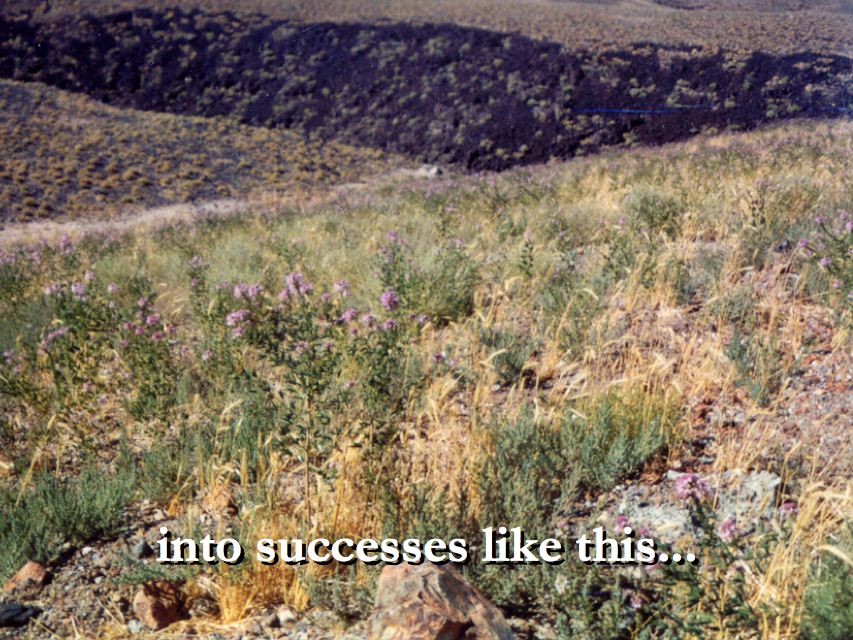
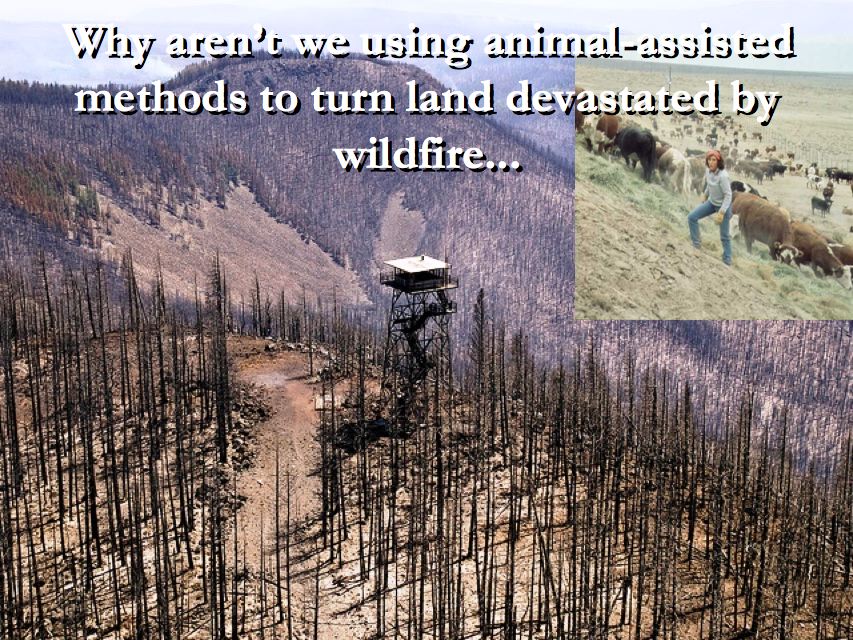
That’s why cattle have been successfully used to restore ecological health to land that has been damaged by mining, by raising crops in ways that exhaust the land’s fertility, and even by the environmentalists’ panacea “protection.” For instance, in Arizona and Nevada, cattle have been used to return native vegetation to denuded mine sites and piles of mine waste on which other forms of reclamation had failed. How do they do it? By stomping in seeds and mulch and nourishing the mixture with their own natural fertilizer. Sheep and goats have been used to create firebreaks and remove nonnative plants at various locations from East to West, and sheep, goats, and cows have been used to revegetate land damaged by catastrophic wildfire. 

I haven’t heard of a single case of soybeans or broccoli being used to achieve any of that.

As for all that cow flattulence and belching the anti-meat folks tout as a cause of global warming, properly grazed grasslands have been shown to be so effective at sequestering carbon in green and growing grass that some ranchers have been able to supplement their income by marketing carbon offsets created by their naturally-managed cattle

That works even if you don't believe in global warming

Acknowledging the effectiveness of these techniques the state of Florida has come up with a plan to contract with ranchers to use their livestock to improve that state’s rangelands’ ability to absorb, clean, and sequester water. One of the aims of this program is to raise the water level in the Everglades. That’s right. Florida is using cows to rewater the Everglades.

On the other hand, when grazers are removed from the land the ecological results can be disastrous.

In Central California, when cattle grazing was removed from seasonal wetlands called vernal pools, the native plants and animals that live there, some of which are endangered, were displaced by nonnative weeds in as few as three years. When grazing was resumed the rare plants and animals returned.

Also in California, the threatened bay checkerspot butterfly has disappeared from lands from which cattle grazing was eliminated -- to protect the butterfly. On lands that continue to be grazed the butterfly has managed to persist.    

Because of this and similar instances “cessation of grazing” has been recognized as one of the main threats to some of California’s most sensitive ecosystems by the California Rangeland Conservation Coalition. That organization includes The Nature Conservancy, Defenders of Wildlife, and Audubon, among others.

And, for those of you who have been reading this blog for a while, you may remember (and want to link back to) the story of the native fish in Arizona (the spikedace) that was sustained by grazing for more than a century and exterminated  in less than a decade by “cessation of grazing,” or the Drake exclosure that’s been protected for more than 60 years and is as bare as a parking lot while the grazed land right next to it is covered with native grasses.

There’s more:

Meat is the only human food that can be raised on land that is officially designated wilderness. Not so with vegetables. 

Meat can be raised on land that can also be used for recreation such as hiking, mountain biking, hunting, fishing, horseback riding, orving, downhill skiing, and birdwatching. Vegetable fields are off limits to most of those. Just try riding your orv or your horse through someone’s field of bok choy.

So, the next time you chow down on a big juicy steak or leg of lamb, give yourself a well-deserved pat on the back for saving the planet, and remember that you are enjoying the only food that can be raised within a diverse, native, openspace ecosystem in such a way that it restores, sustains, and even enhances that ecosystem.

On second thought, maybe you ought to order two steaks. It’s going to take a lot of cows to remedy all the ecological damage perpetrated by vegetarian environmentalists.

Thursday, May 19, 2011

IS NATURE LIBERAL OR CONSERVATIVE?


Why does Nature respond so much more positively to Conservative Environmentalism than to Liberal Environmentalism?

Because Nature has so much more in common with conservatism. 

How so?

Nature operates according to conservative principles. The systems by which Nature functions — ecosystems, habitats, Gaia — can be most accurately described as laissez faire agricultural economies.


For instance: 

Bees, bats, quite a few bird species, and certain varieties of moths pollinate the individuals of certain species plants by feeding on the nectar and pollen within the flowers of those plants and trasnporting some of that pollen to the next flower. This enables those plants to reproduce, which makes for more plants, which makes for more flowers, which makes for more food for bees, bats, birds and moths.

Sounds like an agricultural operation to me. Frankly, it’s not all that different than when we humans raise corn or apples or roses. The only difference is, in the case of bees, flowers, it’s hard to tell which is the user and which is the usee. The plants are using the bees as much as the bees are using the plants. 

Here’s another example.

Beavers create dams which form ponds that provide the beavers with a refuge from predators and a place to build their lodges. At the same time, those ponds create meadows which provide more habitat for more willows and cottonwoods which means more food for more beavers. incidentally, these same ponds form habitat for trout and frogs and a variety of other plants and animals that all play roles as producers and consumers in this pond/meadow agricultural operation.

One more: (one I’m most familiar with.)

Grazing animals, such as wildebeeste, bison, and cattle, feed on grasses, and as they do they shake seeds from the plants and stomp those seeds into the ground along with the fertilizer they (the animals) provide. As the grazers graze, they also remove standing, shade-producing material from last season’s growth (by eating and trampling). This makes sunlight available to new sprouts (from all those seeds) and regrowing plants as well. As the hooved animals scuff around they break up the naturally-occurring ing crust that develops on soil from the impact of wind and falling raindrops and causes the soil to shed some water and absorb less. Hooved animals also pock the soil surface with hoofprints that create small catchments and enhance the soil’s ability to absorb water. 

All of this makes for more grass, which makes for more grazers, which, in turn, makes for more of the predators (lions, Indians, and cowboys) that depend on the grazers for food.  Predators do their part within this natural agricultural system by keeping the grazers moving so they spread their benefits over the largest area possible producing more grass for more grazers which, in turn, produces more food for more predators.  

You don’t believe grazers can produce grasses? Check these posts.

What all this means, as I see it, is Nature is a web of production and consumption relationships. Within Nature, living things work to produce what they need in order to live. Flowers don’t just “happen”. Bees cultivate and produce them. Willows don’t just grow by accident. Beavers create conditions for more of them to grow. Wildebeeste don’t just wander around eating grass, they are herded by predators so they cultivate, plant, and fertilize the grass which they harvest it as they are, in turn, harvested by predators. 

Most, if not all, of these interactions are more complicated than I have just described. For instance, in the case of grazers, grasses, and predators, a variety of creatures perform a number of jobs in this natural agricultural operation. Insects, such as dung beetles, and various microbes break down the manure of the grazers turning it into a form that plants can use as fertilizers. While all this is happening specialized fungi (mycorrhizae) interact with plant roots to enable the roots to take up nutrients from the soil. In each case each participant is producing food for itself as it is used to produce for something else.

Ecologists call this an “ecological community,” a network of interacting species, a food web. Within this community everything plays an essential role in producing what it uses. Want to know what sustains a certain plant or animal. Check what uses it.

There’s another reason Nature can be decribed as conservative (in addition to the fact that it bases the way it functions on the principles of conservatism). Nature can also be called conservative because it has absolutely nothing in common with liberalism. 

In Nature there is no “from each according to his ability, to each according to his needs.” No welfare. No unemployment benefits or food stamps. No minimum or living wage. No bailouts. No income redistribution and no progressive taxation.  

Protection, the core principle of liberal environmentalism, is totally foreign to nature. Nature protects nothing. It uses everything from the waste produced by single-celled creatures, to the oxygen released during photosynthesis in the most gigantic redwood. In Nature to live is to participate in the web of use relationships — to use and be used. There are no exceptions.

Again, if you want to know what sustains some part of Nature, notice what uses it. 

For millenia humans have fit into this economy of natural production and consumption relationships. Much, if not all, of the actions we have used (and continue to use) to produce the food, fiber, and other items we need are as much a part of this ancient web as the actions of any other of its elements — bees, beavers, dung beetles, and mycorrhizae. Obviously, our role within this web has changed drastically because of our development of technology. But we still plant plants and herd animals, and as we play new versions of our ancient roles we still help hold the web together in much the same way that we always have.  

That is why removing humans from Nature a la the Drake Exclosure, the Verde River etc. can have results that can be so ecologically damaging and so counter to our conventional environmental wisdom — the widely-held misconception that removing human impacts from ecosystems always leaves them more “Natural” and better off.

Environmentalists who are also conservative can make use of the huge irony revealed in all of this, an irony that invalidates, contradicts, blows to smithereens the core principle of contemporary liberal environmentalism. The irony consists in this: When liberal environmentalists say “the way to heal any Earthly environment is to ‘return it to Nature’,” what they’re really saying is, the way to solve our environmental problems is to put them into the hands of a competent and dedicated conservative.

That's the right way to be green.

Tuesday, April 19, 2011

TWO QUESTIONS YOU SHOULD BE ASKING ABOUT LIBERAL ENVIRONMENTALISM


After reading in this blog about Liberal Environmentalist policies that: 

1. Exterminated a “Threatened” fish those policies were alleged to save.
2. Attempted to cover up mistake #1 by poisoning an entire stream killing all living things in it, including any other “threatened species” that might live there. On top of all this the poison has been shown to pose a threat of causing onset of Parkinson’s Disease in humans. 
3. Advocate a “restoration” policy that actually has been shown to have made things worse in 60+ years of a trial created to demonstrate the policy's effectiveness.

And... 

After seeing dramatic evidence in comparison photographs revealing that Conservative Environmental policies succeeded in the same cases where liberal methods failed so miserably. (See (name posts))

You should be asking yourself at least two questions.

First:
What are Liberal Environmentalists really trying to do? (Because saving fish, restoring ecosystem health, and the like are obviously not their main goal. In fact they don’t seem to be their goal at all) 

And the second question, which I find much more interesting: 
Why does Nature respond so much more positively to Conservative Environmentalism than to Liberal Environmentalism? 

The quick answer to the second question is: Because Nature is a conservative..., but we’ll get to that in a minute. First I’d like to tackle question #1...

What are Liberal Environmentalists really trying to do?

I’ve spent the last 10 years of my 35+ year career as an environmental activist puzzling over how people who profess to be absolutely dedicated to the environment and its health could harm it in ways such as those I have described in this blog and act as if nothing was wrong.

How could they keep working and fighting so hard to do what they do even though in many cases their actions achieve the exact opposite of what they claim is their life’s purpose? 

FOLLOW THE MONEY?
Some have explained this disconnect by suggesting that environmentalists really don’t care about the environment; that they do what they do because it brings them political power and money, and because it enables them to feel holier than the rest of us, or smarter, or smugger, or greener. Some say environmentalists do what they do because they are socialists or marxists and claiming to defend the environment from capitalism justifies their efforts to destroy it.

All of the above is true, but not in the way most of us think. Actually it is true in a way that even liberal environmentalists are not aware of. Most of the environmentalists I know say that money and power really don’t matter to them. That they are activists purely and solely because of their concern for the health and future of the environment. And I believe they mean that, but consider the following...

All environmentalists I know say they want to “protect” the environment. Nearly every environmental group I know of has the word “protection” either in their name or in their mission statement. (There’s even a group named “Republicans for Environmental Protection.”)

In our society the institution responsible for protecting things is the government. For that reason, whether intentional or not, “protecting the environment” inevitably happens via the government. This puts contemporary environmentalism inescapably in the big government/liberal camp because liberals are the ones who try to solve everything via the government and regulation. 


IF IT MOVES REGULATE IT
For instance: When the banking system almost collapsed in 2008 all we heard from liberals is: The banks need to be more regulated.
When the BP Deep Water Horizon oil well blew up and started spewing oil into the Gulf of Mexico the only solution liberals could conceive of was more regulation.
When Dems declared our health care system didn’t work, the solution, they said, was — more regulation
Global warming — more regulation
Global cooling — more regulation
Severe weather — more regulation
Unemployment too high — more regulation
Economy in crisis — more regulation
Too much oil from overseas— more regulation
Some people have more money than others— more regulation
Endangered species — more regulation
You name it — more regulation, or, in other words, more protection, which means more government.

And in every case, the programs created to administer these regulations — Affirmative Action, Planned Parenthood, Public Health Care, Environmental Protection, Wilderness Designation — extend the authority of government into areas of our lives that range from the most momentous (having or not having children) to the most trivial (what light bulbs we can use.) This, in turn, expands the power over our lives of liberals who advocate and administer these programs.

In other words programs that protect and regulate actually pump political power into the hands of the protectors.


THIS WILL GET YOUR ATTENTION!
Here’s an illustration...

The illustration starts with a question: What modern government passed the first wilderness law, the first endangered species act, the first animal rights laws, the first antivivisection law, was the first to protect wolves, and the first to ban DDT? (Hint: This government was not in the U. S.)

Answer: Nazi Germany passed The Reichsnaturschutzgesetz law (Reich Nature Protection Act) in 1935. The purpose of the act, according to Duncan Bayne in How To Spot a Nazi, was to enable the Nazis to use their purported desire for “preventing harm to the environment" as a justification for increasing control over the German populace. One way in which that worked was by requiring that decisions on how a person could use their property had to be first approved by the Reich. (Sound familiar?)


Nazis considered themselves protectors of the animals as per this cartoon of
rabbits and other animals giving the Nazi salute to Hermann Goering.

Knowing what we know about Nazis, which criterion do you believe German fascists used to judge the success of this law: Whether it protected the environment? or, Whether it expanded their political power?

I’d bet on the latter.

In the same way that the Reich Nature Protection Act expanded the political power of the Nazis in early twentieth century Germany, environmental laws are expanding the political power of the left in the contemporary USA and extending it into all corners of our lives. 

Please note that I’m not saying liberal environmentalists are Nazis or that they hate Jews or want to start a World War. However, there are striking similarities between the two political movements. Both allege that they are the one and only true friend of Nature. Both believe that they are mankind’s only hope to avoid destruction, that they are destined, no, required to lead, and that they are the only ones with the answers and the remedy to heal what ails the world. 

With that as a basis, the Nazis believed and contemporary liberal environmentalists believe that there is no aspect of your life so personal, so private, or so trivial that they should not control it. (In this regard enviros may even be outdoing the Nazis. I know of no attempt by the Third Reich to control the number of sheets of toilet paper you should use or to dictate how much salt you put on your food.)

(See note below for something too outrageous to include here.)

I also believe that this provides us with the answer to question # 1: What are Liberal Environmentalists really trying to do? (Because saving fish, restoring ecosystem health, and the like are obviously not their main goal.), 

Environmentalists didn’t admit failure when their removal of cattle from along the Verde River apparently caused the demise of the Verde River spikedace for the simple reason that, for them, it wasn’t a failure. They succeeded in forcing the U. S. Forest Service to remove cattle and private management from public lands along the river, which is what they intended to do. Concern for the spikedace merely provided the cover and the means to do the job. In other words, they achieved their goal. They increased their political power.

Dead spikedace or no, the program was a success.

WHY YOU SHOULD READ THIS BLOG (BECAUSE IT PROVIDES EVIDENCE OF LIBERALISM’S FAILURES FROM A NEW SOURCE: NATURE HERSELF)
Last, but not least, consider this footnote. Conservative pundits have been telling us for years that liberal programs such as the War on Poverty, Affirmative Action, etc. are a failure, but the evidence they provide is at least open to interpretation. The case of the Verde River spikedace, the Drake Exclosure, the Southwestern Willow Flycatcher and others yet to come on this blog give us concrete evidence that liberal programs don’t work — evidence in the form of dead fish, barren landscapes, and birdless habitats. Better yet, that evidence is provided by none other than Nature itself.

Environmentalists have a saying: “Nature bats last.” On this blog, she bats next when we consider question #2: 

Why does Nature respond so much more positively to Conservative Environmentalism than to Liberal Environmentalism?

Stay tuned.

NOTE:
(I include this here, because if I had added it earlier, it would have overshadowed this post to the point that you might not have been able to read the rest of it, let alone remember it.)

The most chilling similarity between Contemporary Liberal Environmentalists and Hitler’s Nazis is: The “solutions” offered by both for the world’s problems, environmental and otherwise, include the elimination of huge numbers of humans. For instance, when the “2006 Distinguished Texas Scientist,” advocated the elimination of 90 percent of Earth's population by airborne Ebola (a viral disease that causes people to bleed to death through their bodily orifices). He was given a standing ovation by the Texas Academy of Science.